Commercial Permission · Protected Architecture · Defined Scope
License Architecture That Can Support the Claim
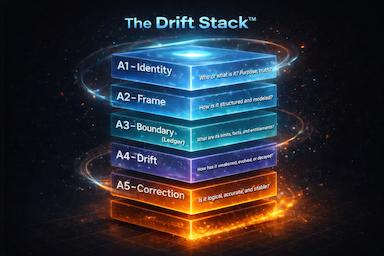
The Drift Stack™
Identity → Frame → Boundary → Drift → Correction
The commercial relationship
What Licensing Does
Licensing is the commercial permission to implement and use Samirac architecture within an agreed product, system, deployment, or platform scope.
It is not a general endorsement, a consulting retainer, or an automatic certification. It establishes the implementation rights, support boundaries, deployment rights, and protected claims available to the licensee.
A builder may license the architecture for a single bounded application. An enterprise may license it for an internal or externally facing system. A platform provider may require broader integration, redistribution, or OEM rights.
The scope follows the authority and deployment surface—not merely company size.
Protected systems and mechanisms
What You Are Licensing
Drift Stack™
Architecture for identity, frame, coherence boundary, authoritative state, drift detection, and external correction across systems that must remain stable over time.
SAQ™ Unified Trust Stack™
Identity, authority, and pre-execution admissibility mechanisms for systems that can trigger, deny, decide, enforce, automate, or change state.
DeltaDrift™
Detection, invalidation, and correction mechanisms for persistent, adaptive, multi-agent, or authority-bearing systems with meaningful drift surfaces.
These are not hosted models or generic recommendations. They are architecture, control mechanisms, specifications, standards, implementation methods, and associated marks for systems that can affect real state or outcomes.
Typical commercial structures
Licensing Models & Typical Ranges
Pricing is driven by what the system can do, the authority it carries, the number and type of deployments, and the commercial rights required.
Builder / Application License
One bounded application in development. Designed for solo developers and small teams applying the architecture to a real product.
$500–$1,000 / year
Usage License
Internal systems or limited production deployments with defined users, actions, authority, and operational boundaries.
$2k–$10k / year
Integration License
SaaS, multi-tenant, externally facing, or enterprise-integrated systems with meaningful execution authority and broader deployment rights.
$10k–$50k+ / year
OEM / Platform License
Embedded, redistributed, white-labeled, or platform-level use with broad or cascading identity, authority, and action surfaces.
Custom scope
Final scope and pricing are confirmed after the identity, authority, deployment, drift, support, and conformance surfaces are understood.
Clear support boundaries
What the License Includes—and What Requires Separate Scope
Included Within the Agreed Scope
- Architecture onboarding and education
- Application and authority-surface scoping
- Scheduled architecture and design reviews
- Implementation guidance at defined checkpoints
- Conformance preparation and evidence planning
- A defined correction and review cycle
Separately Scoped When Needed
- Full application development performed by Samirac
- Large migrations or substantial product rewrites
- Custom enterprise or third-party integrations
- Ongoing operational support or incident response
- Hosting, infrastructure, and external vendor costs
- Work outside the licensed implementation scope
A deeper co-build, product, or joint-venture relationship is handled through the partner pathway rather than being silently folded into a standard license.
Application ownership and protected IP
You Keep Your Application
You Retain
- Application and application-specific source code
- Proprietary workflows and business logic
- Customer relationships and commercial accounts
- Application data and domain-specific content
- Brand, product positioning, and market strategy
Samirac Retains
- Drift Stack™, SAQ™, and DeltaDrift™ architecture
- Specifications, standards, and reusable control mechanisms
- Certification criteria and conformance requirements
- Protected methods, reference materials, and implementation patterns
- Trademarks, certification marks, and associated intellectual property
Three different claims
License, Conformance, and Certification
License
Grants defined implementation and commercial-use rights within the licensed scope.
Conformance
Describes whether the implemented system satisfies the applicable architectural and execution-control requirements.
Certification
Formally recognizes demonstrated capability or system evidence within the stated scope: Executive reasoning, Builder implementation capability, or System conformance.
A license opens the implementation pathway. Evidence earns the conformance or certification claim.
From scope to supported claim
How Licensing Begins
1. Define the System
Identify what the application does, who or what may act, where state persists, and which actions require governed authority.
2. Establish the Scope
Confirm the licensed architecture, deployment rights, implementation boundaries, review checkpoints, and commercial model.
3. Implement the Architecture
Apply the licensed mechanisms inside the actual application through the agreed build, review, and correction process.
4. Support the Claim
Prepare the evidence required for conformance review or certification when the application is ready to make a formal claim.
SAQ™ and DeltaDrift™ mechanisms are addressed by filed and pending U.S. patent applications. Licensing grants defined implementation and use rights under the applicable agreement. Ownership remains with Samirac Partners LLC.
Commercial Licensing
Define the implementation, deployment rights, support boundary, and claim before the license is executed.
Solo builders, product teams, enterprises, and platform providers are scoped according to the real system—not forced into the same commercial model.