Guided Reading Track · Database-Driven
Executive Track
A guided reading path for boards, executives, technology leaders, and risk leaders navigating AI adoption, governance, execution authority, liability, and runtime control.
Follow the sections in order for the guided path, or move to the full Reading Spine to browse the complete 137-article corpus by subject.
Structure first. Authority before execution.
What This Track Is
A guided reading path for boards, executives, technology leaders, and risk leaders navigating AI adoption, governance, execution authority, liability, and runtime control.
4 ordered sections · 18 article placements. The page structure and article order are loaded from the Samirac database.
For Boards: Oversight, Liability & Duty of Care
Board responsibility is not mastering every technical detail. It is ensuring that accountability, authority, and institutional risk remain governable as AI systems become capable of taking or influencing consequential action.
- Liability Will Land on the Systemnot the model, not the operatory, the system.Explains why responsibility attaches to the deployed system, organization, and operating architecture rather than the model alone.4 min read
- Most AI Governance Is Still ObservationalShows why observing, auditing, and explaining after execution is not the same thing as controlling execution.4 min read
- Governance Does Not Control Runtime ExecutionArchitecture and Code are the enforcementClarifies why governance frameworks must eventually connect to runtime authority and enforceable system behavior.5 min read
- The Real Risk of AI Agents Isn’t Hallucination — It’s Massive Institutional LiabilityThe moment AI agents gain execution authority inside real systems, the problem stops being hallucination and becomes institutional liability.Frames agentic AI risk as institutional exposure once systems are connected to tools, workflows, customers, and authority.11 min read
For Executives: Adoption, Readiness & Strategic Direction
Most AI failures begin before deployment. This section focuses on organizational maturity, use-case selection, readiness, prioritization, and the leadership decisions required before AI becomes operational.
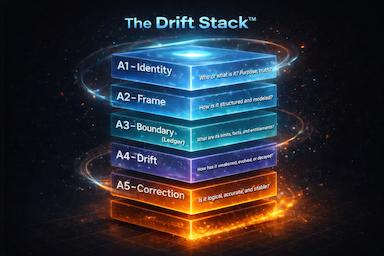
- The Complete AI JourneyA continuous Framework for SuccessIntroduces the connected operating model: Lifecycle Maturity, AI RADAR™, Runtime Governance, and Drift Stack™.5 min read
- AI Lifecycle Maturity Model™Understanding Organizational Readiness for Artificial IntelligenceExplains how organizations mature from experimentation into durable, governed AI operations.47 min read
- The LLM Is Not the SystemWhy Real AI Requires Architecture Above and Around the ModelSeparates model capability from the larger system that grants authority, connects tools, and produces consequences.7 min read
- Rent the Model. Own the System.If Pricing Changes Can Kill Your AI App, You Built It WrongFrames the strategic ownership problem: organizations may rent model capability, but they must own the system, authority, and execution architecture around it.4 min read
- Architecture Is What Saves YouWhat Large-Scale Systems Eventually Teach EveryoneExplains why architecture, not tool enthusiasm, is what protects organizations as AI systems become operational.5 min read
Industry-Specific Proofs
These pieces show the same governance and drift pattern appearing across high-consequence domains where intent, documentation, and compliance are not the same thing as control.
- Manufacturing Has Been Describing Drift for 60 Years — They Just Didn’t Know It(a.k.a. the thing Michael “Word Salad” M. could not see)Connects industrial process control and continuous improvement to the same structural drift problem appearing in AI.5 min read
- Epidemiology and the Drift Stack — Why Disease Spread Follows the Same 5-Stage Collapse LawUses disease spread as a proof surface for drift, boundaries, correction, and systemic propagation.6 min read
- Gold Doesn’t Hedge InflationGold Hedges Invalid AuthorityFrames gold as a hedge against invalid authority rather than simply a hedge against inflation.5 min read
- Europe Is Regulating AI Without Understanding the System — and That’s the Real RiskIt’s the Peter Principle applied to governance.Applies the architecture problem to regulation and shows why governing the wrong layer creates systemic risk.6 min read