Live Instruction · Structural Thinking · Workflow Redesign

Structural AI for the Workplace

Teach employees to eliminate unnecessary work, redesign broken processes, and use AI where it creates measurable value.
Most AI courses teach employees how to perform assigned tasks faster. This course teaches them how to determine whether the work should be done at all.
Five live sessions. Two hours per day. Live demonstrations. Prepared workplace examples. Guided exercises. No prerecorded videos and no self-paced modules.Class is now in sessionNext public cohort: August 24–28, 2026 · 9:00–11:00 AM Central Time· Live on Zoom · Limited seats available
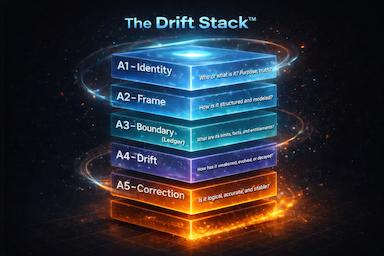
The Drift Stack layered architecture: Identity, Frame, Boundary, Drift, and Correction

The Drift Stack™

Identity → Frame → Boundary → Drift → Correction

THE BUSINESS CASE IS SIMPLE

A company does not need to save many employee hours to recover the cost of better structural thinking and more effective AI use.

10 Employees

More Than 1,000 Hours

Ten employees eliminating only two wasted hours per week recover more than 1,000 hours of organizational capacity each year.

100 Employees

More Than 10,000 Hours

Across 100 employees, the same modest improvement represents more than 10,000 hours of work capacity annually.

At an illustrative fully loaded labor value of $50 per hour, 1,000 recovered hours represent approximately $50,000 in organizational capacity.

Illustrative example only. Actual time savings and financial value depend on the organization, workflows, implementation, adoption, and employee roles.

Those hours are often buried inside duplicate reporting, unnecessary meetings, repeated interpretation, broken handoffs, avoidable corrections, unclear approvals, and work performed only because nobody has examined why it exists.

Saving five minutes on a bad task is not transformation. Eliminating the bad task is.

This Is Live Working Instruction

LIVE TRAINING. LIVE EXAMPLES. NO VIDEOS.

Every session is taught live by Chris Ciappa. Concepts are explained live. Examples are worked through live. Questions are answered live. Participants complete guided exercises while the instruction is happening.

This is not an online video library, a collection of prerecorded webinars, or a self-paced course designed to be purchased and forgotten.

This is live working instruction—not content consumption.

AI TRAINING USUALLY STARTS TOO LATE

Employees are often taught prompts, tools, and shortcuts before anyone has examined the process being accelerated.

Traditional AI Training

  • • Begins with the tool
  • • Focuses on prompt techniques
  • • Accelerates the existing task
  • • Treats activity as productivity
  • • Measures adoption instead of business value

Structural AI for the Workplace

  • • Begins with the intended result
  • • Maps how the work actually happens
  • • Finds where the process is breaking
  • • Eliminates unnecessary work first
  • • Applies AI only where it creates measurable value

AI can accelerate good thinking.
It can also industrialize bad thinking.

The Structural AI Method

Participants learn a repeatable method they can apply to workplace processes long after the live course is complete.

Understand the Result

Begin with the result the work is supposed to produce, not the tool or task currently being used.

Follow the Process

Trace how information, decisions, approvals, handoffs, and actions move through the organization.

Find the Failure Point

Identify where delay, duplication, ambiguity, rework, or unnecessary effort actually enters the workflow.

Redesign the Work

Eliminate or simplify unnecessary work before introducing automation or AI assistance.

Apply AI Carefully

Use AI for bounded assistance without silently transferring judgment, authority, or accountability.

Measure the Outcome

Track hours recovered, cycle-time reduction, errors prevented, and work that no longer needs to occur.

Result → Process → Failure Point → Redesign → AI Assistance → Verification → Measurement

FIVE DAYS OF LIVE, APPLIED INSTRUCTION

Participants learn the Structural AI method through live explanation, live demonstrations, prepared workplace examples, guided exercises, and group discussion.

Five Live Days

One focused instructor-led session each day.

Daily Schedule

9:00–11:00 AM Central Time each day.

Live Examples

Prepared workplace scenarios are examined and redesigned in real time.

Guided Exercises

Participants practice the method using structured course scenarios.

No prerecorded instruction. No self-paced video modules. No generic prompt library substituted for structural understanding.

Five-Day Live Curriculum

Each live session builds from structural understanding to practical workplace application.

Day 1

Learn to Think Structurally

Learn to distinguish the visible task or symptom from the process that is supposed to produce the result.

Live Instruction

  • Results, processes, tasks, and symptoms
  • How unnecessary work becomes institutionalized
  • Why accelerating the wrong work creates more waste
  • How to follow a problem to the actual failure point

Live Example

A prepared workplace scenario involving repeated reporting, conflicting requests, unnecessary approvals, and work that no longer supports the intended result.

Guided Exercise

Use the Structural Work Analysis worksheet to separate the visible task from the underlying process and intended business outcome.

Day 2

Map How Work Actually Happens

Build a clear current-state view of a workflow before attempting to improve or automate it.

Live Instruction

  • Inputs, outputs, decisions, and handoffs
  • Ownership, authority, approvals, and exceptions
  • Evidence required to complete the work
  • Where delays, duplication, and rework enter the process

Live Example

A prepared workflow involving information gathering, repeated interpretation, multiple handoffs, and unclear ownership.

Guided Exercise

Map the scenario from beginning to end and identify where time, effort, and information are being lost.

Day 3

Determine Where AI Belongs

Separate work AI can safely assist from decisions and actions requiring human judgment, authority, or accountability.

Live Instruction

  • AI assistance versus AI authority
  • Drafting, summarizing, extracting, comparing, and organizing
  • Sensitive information and workplace safeguards
  • When human review, escalation, or approval must remain

Live Example

A prepared scenario in which AI can support several steps but should not control the final decision or resulting action.

Guided Exercise

Classify each activity as eliminate, simplify, assist, automate, retain, or escalate.

Day 4

Redesign Before You Automate

Remove unnecessary work and repair the process before using AI to accelerate what remains.

Live Instruction

  • Eliminating work that should not exist
  • Reducing handoffs and repeated interpretation
  • Designing bounded AI-assisted tasks
  • Building verification into the workflow

Live Example

A live redesign of a prepared workplace process showing how the workflow changes before and after structural analysis.

Guided Exercise

Redesign the prepared scenario and determine where AI can provide bounded, measurable assistance.

Day 5

Measure Value and Prepare Implementation

Translate structural improvements into measurable business outcomes and a practical implementation approach.

Live Instruction

  • Estimating hours recovered
  • Measuring cycle-time and error reduction
  • Defining human accountability
  • Creating an implementation plan

Live Example

A completed example showing the original workflow, structural failure, redesigned process, AI role, safeguards, and estimated annual impact.

Guided Exercise

Complete the value-estimation and implementation-planning worksheets using the course scenario.

PRACTICE THE METHOD THROUGH LIVE EXAMPLES

The public cohort uses prepared workplace scenarios covering reporting, information gathering, approvals, document review, repeated handoffs, duplication, correction, and unnecessary work.

The public cohort teaches the method through live instruction, prepared examples, guided exercises, and group discussion.

Participants are not asked to submit personal, confidential, or company-specific workflows for individual analysis.

Prepared Workplace Scenarios

  • • Repeated reports and summaries
  • • Manual information gathering
  • • Duplicate data entry and transfer
  • • Repeated document review
  • • Slow approvals and unclear handoffs
  • • Recurring internal requests
  • • Processes producing frequent rework
  • • Work dependent on repeated interpretation

Questions Participants Learn to Ask

  • • Why does this process exist?
  • • What result should it produce?
  • • Which steps create actual value?
  • • Where is time and effort being lost?
  • • Which steps can be eliminated?
  • • Where can AI assist safely?
  • • What must remain under human judgment?
  • • How should improvement be measured?

Participant Resources

Participants receive practical materials they can continue using after the live instruction is complete.

Structural Work Analysis workbook

Current-state workflow mapping template

Waste and failure-point analysis worksheet

AI task suitability framework

Workflow redesign template

Human authority and verification checklist

Annual hours-recovered calculator

Implementation-planning worksheet

Certificate of completion

Who This Course Is For

No software-development background is required. The course is designed for people who perform, manage, improve, or make decisions about workplace processes.

Operations and administrative professionals

Managers and department leaders

Finance, legal, compliance, and risk teams

Customer service and support professionals

Technology, data, and product teams

Professional-services organizations

Organizations beginning employee AI adoption

Teams experiencing duplication, delay, or repeated rework

Choose the Right Live Course

The public cohort teaches the Structural AI method through prepared examples. The private company cohort applies the method directly to the organization.

Individual Registration

Public Live Cohort

Learn the Structural AI method through live instruction, live demonstrations, prepared examples, guided exercises, and group discussion.

$750

Per participant

Next public cohort

August 24–28, 2026

9:00–11:00 AM Central Time

Five live two-hour Zoom sessions

The session time is the same each day.

Limited seats available

  • Five live instructor-led Zoom sessions
  • 9:00–11:00 AM Central Time each day
  • Live demonstrations and prepared workplace examples
  • Guided exercises using structured course scenarios
  • Group discussion and questions about the method
  • Structural AI workbook and practical templates
  • Implementation-planning tools
  • Certificate of completion
Reserve Next Cohort Seat — $750 →

Limited seats are available for the next public cohort. A seat is not reserved until payment is received. Registration closes when the cohort is full.

Private Organizational Delivery

Private Company Cohort

Apply the Structural AI method directly to your organization's workflows, operating problems, and AI opportunities.

$12,500

Starting price for up to 10 participants

Flexible Private Delivery

Zoom, Microsoft Teams, Google Meet, your organization's preferred secure platform, or on-site by arrangement

Company-specific workflows and problems

  • Five private live instructor-led sessions
  • Up to 10 company participants
  • Pre-course organizational intake
  • Actual company workflows and operating problems
  • Confidential company-specific discussion
  • Live analysis and problem-solving
  • Direct examination of selected workflows
  • Applied workflow redesign
  • AI opportunity identification
  • Leadership findings and recommended next steps
Discuss a Private Company Cohort →

Larger groups, additional workflows, executive sessions, extended delivery, and implementation support are scoped separately.

The Public Cohort Teaches the Method

Participants learn through live instruction, prepared examples, guided scenarios, group discussion, and practical course materials.

The public cohort does not include confidential company analysis, proprietary workflow review, or individual consulting engagements.

The Private Cohort Applies the Method

The organization brings actual workflows, bottlenecks, operating problems, and candidate AI opportunities into a private environment for live examination and applied problem-solving.

Private delivery includes preparation, company-specific analysis, selected workflow redesign, and organizational findings.

Private Company Engagement

BRING YOUR ACTUAL WORKFLOWS

The private company cohort moves beyond general instruction. Before the course begins, the organization identifies selected workflows, recurring operating problems, and areas of wasted employee capacity.

Those company-specific situations become part of the live instruction, analysis, and applied problem-solving throughout the engagement.

Actual Workflows

Examine selected internal processes, handoffs, approvals, information flows, and sources of repeated work.

Actual Problems

Identify where waste, delay, ambiguity, error, rework, or unnecessary organizational effort is being created.

Applied Redesign

Redesign selected processes and determine where AI can improve work without weakening judgment, authority, or accountability.

FROM WORKPLACE IMPROVEMENT TO ENTERPRISE AI STRATEGY

Structural AI for the Workplace and AI RADAR™ solve different problems, but they can work together.

Structural AI for the Workplace

Teaches people how to understand work, identify waste, redesign processes, and recognize practical opportunities for AI assistance.

AI RADAR™

Helps the organization determine which larger AI opportunities are valuable, appropriate, governable, and aligned with its readiness and maturity.

When training reveals repeated organizational problems, cross-functional workflow failures, candidate automation opportunities, or broader deployment questions, AI RADAR™ provides the next structured evaluation layer.

Live Instructor

Chris Ciappa

Founder and Chief Coherence Architect, Samirac Partners LLC

Chris brings more than twenty years of enterprise technology, business intelligence, data warehousing, analytical architecture, consulting, product development, and hands-on system implementation experience.

His work focuses on understanding how business processes, information, decisions, authority, architecture, and consequences operate as one connected system.

Structural AI for the Workplace combines that operating experience with current AI architecture, readiness, implementation, governance, and execution-control work.

Every session is taught live by Chris. The instruction, demonstrations, examples, questions, and exercises happen in real time.

Live Training • Live Examples • Applied Exercises

DO NOT AUTOMATE WASTE.

TEACH PEOPLE TO SEE THE SYSTEM.

Give employees a repeatable way to understand how work produces results, identify where effort is being lost, and use AI to create measurable improvement.

Class is now in session
Next public cohort: August 24–28, 2026
9:00–11:00 AM Central Time · Limited seats available

No prerecorded videos. No self-paced course library. Every session is live.

Structural Thinking • Workflow Improvement • AI Assistance • Human Judgment • Measurable Value